

Why Placing Cabinet Handles the Right Way Changes Everything
Placing cabinet handles in the right spot is one of the easiest ways to make your kitchen look professionally designed — or, if done wrong, obviously DIY.
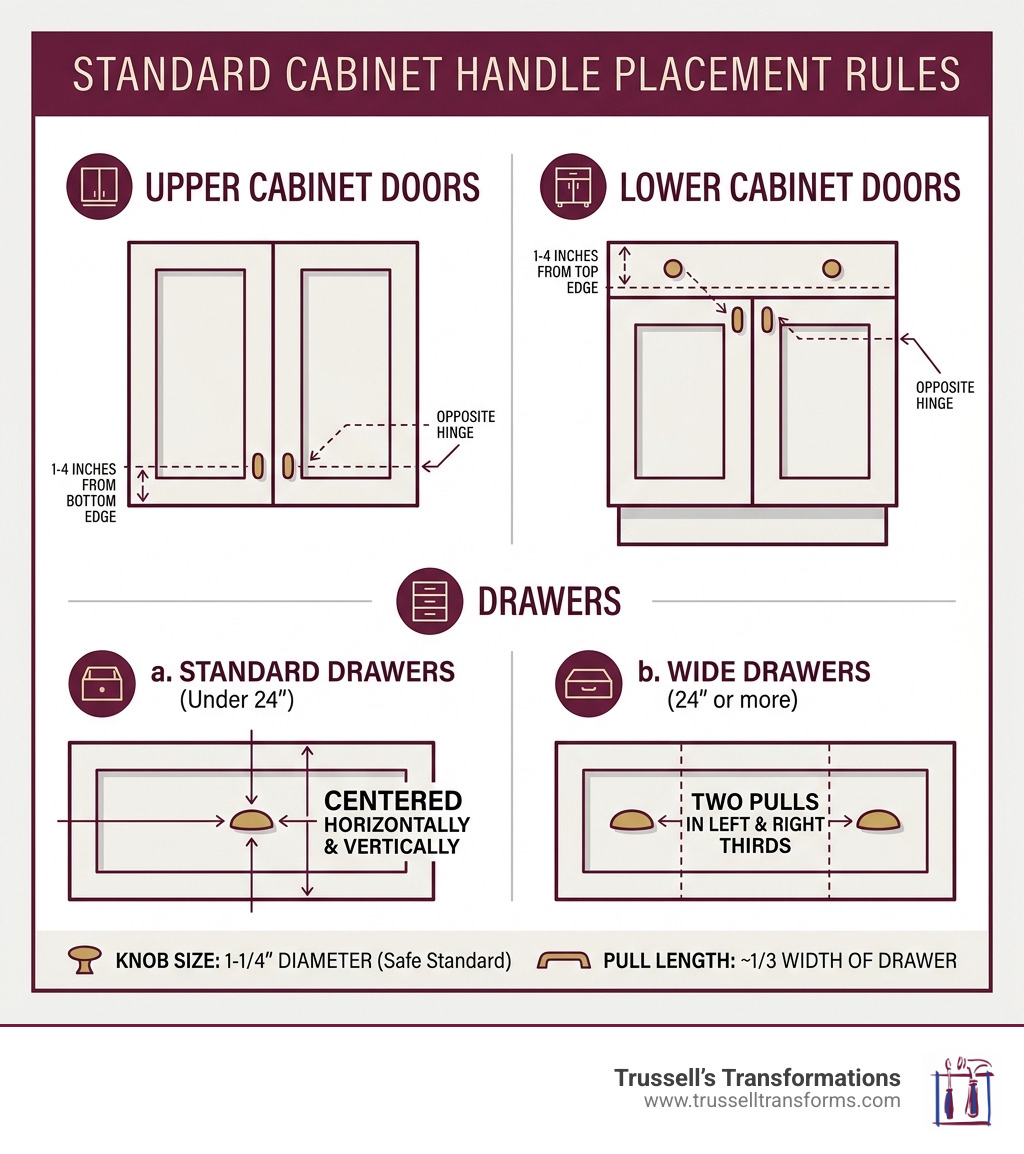
Here’s a quick reference for standard cabinet hardware placement:
| Location | Placement Rule |
|---|---|
| Upper cabinet doors | 1-4 inches from the bottom edge, opposite the hinge |
| Lower cabinet doors | 1-4 inches from the top edge, opposite the hinge |
| Standard drawers (under 24″) | Centered horizontally and vertically |
| Wide drawers (24″ or more) | Two pulls placed in the left and right thirds |
| Knob size | 1-1/4″ diameter is the safe standard |
| Pull length | Approximately 1/3 the width of the drawer |
Hardware is often called the jewelry of a kitchen — and for good reason. It’s one of the last things installed, but one of the first things people notice. A pull that’s a quarter-inch off, or a knob drilled at the wrong angle, can throw off the look of an entire run of cabinets.
The stakes are real. Getting placement right before you drill ensures a flawless finish that highlights the quality of your cabinetry — which is exactly why precision matters so much.
This guide walks Albuquerque homeowners through everything: choosing the right hardware for your cabinet style, measuring and marking with confidence, and knowing when a licensed installer is worth every penny.
Choosing the Right Hardware for Your Cabinet Style
Before we pick up a drill, we have to talk about the “what” and the “where.” The style of your cabinetry largely dictates the type of hardware that will look best. At Trussell’s Transformations, we work with industry-leading brands like Durasupreme Cabinetry, Waypoint Living Spaces, Sollid Cabinetry, and Kitchen Cabinet Distributors. Each of these lines offers unique profiles that respond differently to hardware.
Knobs vs. Pulls
The age-old question: knobs or pulls? Traditionally, knobs were for doors and pulls were for drawers. However, modern design has blurred these lines.
- Knobs: These require a single screw and are generally easier to install. They are excellent for smaller cabinet doors or for achieving a classic, understated look.
- Pulls: These offer more “grip” and are often more ergonomic for those with limited hand mobility. They provide a linear look that can emphasize the width of your drawers or the height of your pantry doors.
Understanding Placement for Different Cabinet Types
The construction of your door determines where the hardware physically can go.
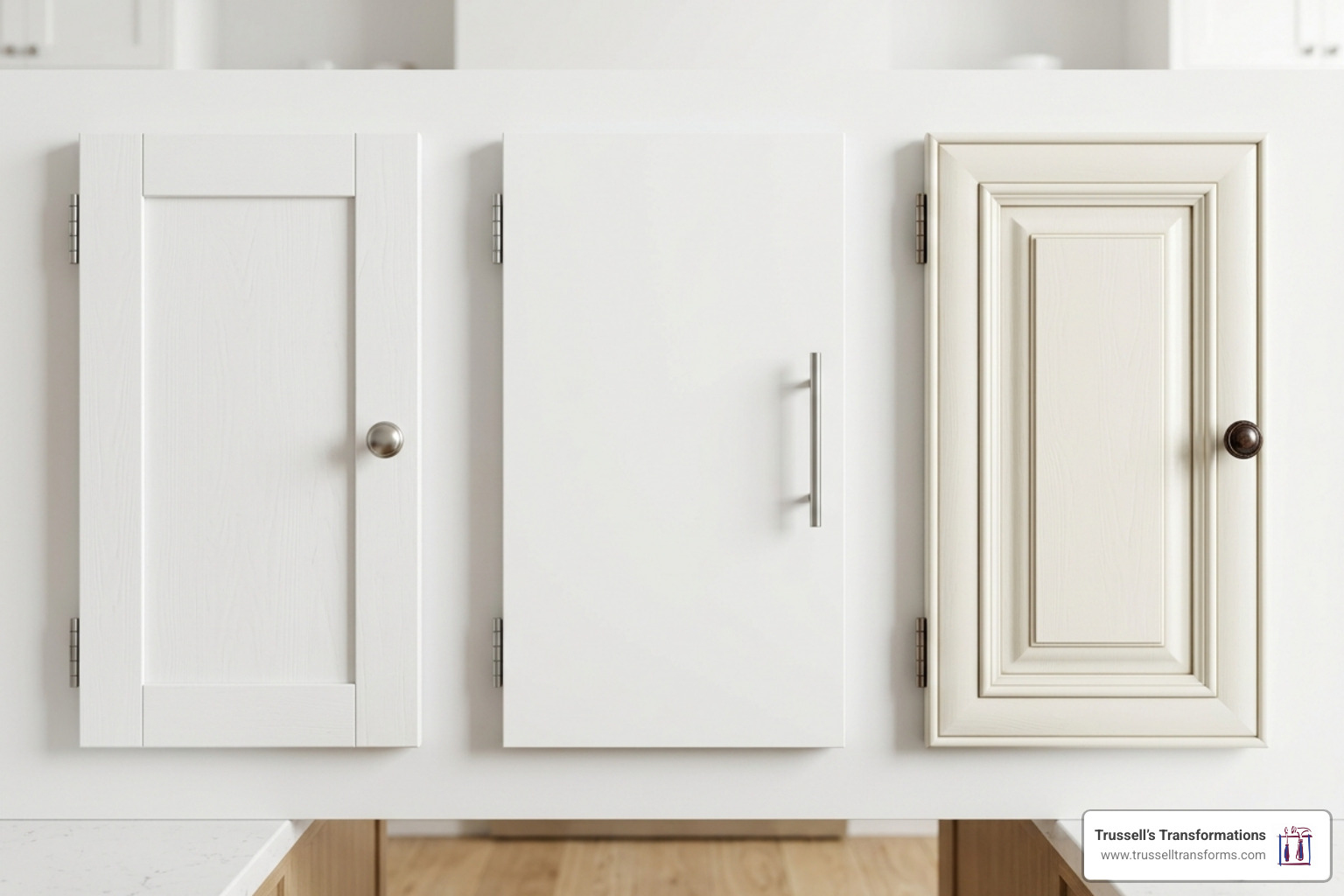
- Shaker Cabinets: These feature a five-piece design with a recessed center panel. Hardware is almost always placed on the “stile” (the vertical side piece) or the “rail” (the horizontal piece).
- Slab Doors: These are flat, modern surfaces. Because there is no frame, you have more creative freedom, but consistency is even more critical because there are no natural lines to hide a mistake.
- Traditional Raised Panels: These have more “mountain and valley” contours. You’ll want to ensure your hardware sits on a flat portion of the frame to avoid a wobbly handle.
Sizing Guidelines for Placing Cabinet Handles
Size matters. If a pull is too small, it looks like an afterthought; if it’s too big, it can overwhelm the room.
- The 1-1/4″ Rule: For knobs, a 1-1/4″ diameter is considered the “goldilocks” size—not too big, not too small.
- The 1/3 Rule: For pulls, a great rule of thumb is that the pull should be approximately 1/3 the length of the drawer width.
- Small drawers (12″ or less): Use 3″ to 4″ pulls.
- Medium drawers (12″ to 30″): Use 4″ to 8″ pulls.
- Large drawers (30″ to 48″): Look for pulls longer than 8″.
- Grip Space: Ensure there is at least 1-1/2″ of clearance between the handle and the cabinet so your fingers don’t feel cramped.
Mixing Finishes for a Designer Look
You don’t have to use the same finish for every single piece of hardware, but you do need cohesion. We often suggest keeping the hardware finish consistent across all cabinetry while perhaps mixing the metal of your faucet or lighting.
- Matte Black: Provides a dramatic, modern flair and hides fingerprints well.
- Brushed Nickel: A versatile, timeless choice that pairs beautifully with stainless steel appliances.
- Polished Chrome: Adds a high-end, jewelry-like sparkle to the room.
- Brushed Gold/Brass: Adds warmth and a touch of luxury, especially against navy or white cabinets.
Standard Rules for Placing Cabinet Handles on Doors and Drawers
Accuracy is the difference between a kitchen that looks like a million bucks and one that feels incomplete. When placing cabinet handles, we follow strict ergonomic and aesthetic standards.
Placement on Upper and Lower Cabinet Doors
For doors, the goal is leverage. You want the handle to be in the corner furthest from the hinges.
- Vertical vs. Horizontal: On doors, pulls should almost always be installed vertically. On drawers, they go horizontally.
- The 1-4 Inch Rule: Hardware should typically be placed 1 to 4 inches from the top or bottom edge of the door.
- Upper Cabinets: Place the hardware 1-4 inches from the bottom corner (opposite the hinge). This keeps it within easy reach.
- Lower (Base) Cabinets: Place the hardware 1-4 inches from the top corner. This prevents you from having to bend down too far to open the door.
- Double-Stacked Cabinetry: If you have cabinets that go all the way to the ceiling, consider using knobs or latches on the very top row to maintain proportionality.
Placing Cabinet Handles on Wide and Deep Drawers
Drawers require a different strategy. While centering is the standard for small drawers, wide drawers (anything 24 inches or wider) require the Rule of Thirds.
- The 24-Inch Rule: If a drawer is 24″ or wider, a single small pull in the center can look lost.
- Double Pulls: For these wide drawers, divide the drawer face into thirds. Place one pull in the center of the left third and one in the center of the right third to ensure balanced weight distribution and smooth operation of the drawer glides.
- Appliance Pulls: For built-in refrigerators or dishwashers, you cannot use standard cabinet pulls. These appliances require “appliance pulls,” which are heavy-duty and come with larger bolts to handle the force required to break a vacuum seal.
Tools and Techniques for a Mistake-Free Installation
In our 25+ years of remodeling in Albuquerque, we have found that the right tools are the key to a professional-grade installation. Most projects benefit significantly from using specialized equipment.
Must-Have Installation Tools
- Cabinet Jigs: This is a professional’s best friend. A jig is a pre-set tool that clamps onto your door and ensures every hole is drilled in the exact same spot.
- Painter’s Tape: Place a piece of tape where you intend to drill. It ensures a clean entry point for the drill bit and allows you to mark your measurements clearly with a pencil.
- 3/16-inch Drill Bit: This is the standard size for most cabinet hardware screws. Always test on a scrap piece of wood first!
- Laser Levels: For long runs of drawers, a laser level ensures that the horizontal line of handles is perfectly straight across the entire kitchen.
- Mounting Putty: Use a bit of sticky tack or putty to “stick” the hardware to the cabinet before drilling. Step back and look at it from across the room to ensure you like the placement.
Professional Installation vs. DIY
While many homeowners in Rio Rancho and Bernalillo County enjoy the DIY route, there are significant advantages to hiring licensed contractors.
| Feature | DIY Installation | Professional Installation (Trussell’s) |
|---|---|---|
| Consistency | Variable | Guaranteed (Laser-aligned) |
| Speed | 4-8 hours for a full kitchen | 1-2 hours |
| Precision | Manual measurement | Professional jigs included |
| Tools | Must purchase or rent | Professional equipment included |
| Warranty | None | Workmanship guarantee |
At Trussell’s Transformations, we are a one-stop shop. Whether you are choosing high-end countertops from Caesarstone, Cambria, Silestone, or The Stone Collection, or selecting your dream cabinets, our team ensures the final hardware installation is the perfect finishing touch.
Common Mistakes to Avoid
- Ignoring Countertop Overhang: If your handles stick out too far, they might hit your hips as you walk by or interfere with a nearby drawer. Always check the “projection” of the handle.
- Incorrect Screw Length: Most hardware comes with two sets of screws. Use the shorter ones for doors and the longer ones for drawers (which usually have a drawer box and a decorative front to go through).
- Rushing: Taking your time is the #1 way to ensure a perfect first attempt. Measure twice, mark once, and then check it again.
- Style Clashing: Don’t put ultra-modern, 12-inch bar pulls on a tiny, ornate traditional cabinet. Match the scale and the vibe.
Frequently Asked Questions about Cabinet Hardware
Should I use knobs or pulls on my cabinets?
It is largely a matter of personal preference! A popular “designer look” is to use knobs on upper cabinets and pulls on lower cabinets and drawers. This offers the best of both worlds: the clean look of knobs at eye level and the functional grip of pulls where you need them most.
How do I ensure all my handles are perfectly aligned?
The secret is using a master template. Whether you buy a professional metal jig or make one out of a piece of cardboard, using the same guide for every door ensures that the distance from the edge is identical across the entire kitchen. Using a laser level to project a straight line across drawer banks is also a pro tip we use daily.
What size pull is best for a 30-inch drawer?
Following the 1/3 rule, a 10-inch pull is ideal for a 30-inch drawer. This provides enough visual weight to balance the large drawer face and makes it easy to open with one hand.
Conclusion
Placing cabinet handles might seem like a small detail, but it’s the detail that ties your entire home renovation together. Whether you’re refreshing your current space or starting a full remodel in Albuquerque, getting the hardware right is essential for both beauty and daily function.
At Trussell’s Transformations, we’ve spent over 25 years helping our neighbors in Albuquerque, Rio Rancho, and Bernalillo County create spaces they love. From our 0% financing options to our expert licensed contractors, we make the process stress-free.
Ready to see the latest trends in hardware and cabinetry? Visit our showroom at 8023 Edith Blvd NE, Albuquerque, NM 87113. Our team can help you select the perfect combination of Durasupreme, Waypoint, or Sollid cabinetry paired with stunning hardware that makes your kitchen shine.
Transform your kitchen with professional cabinet installation — contact us today for a final design consultation!
Recent Comments