

Most Popular Countertop Edge Profiles for Kitchen and Bath Design
Countertop edge profiles define the finished perimeter shape, functional comfort, and architectural style of your stone surfaces. Common profiles include clean, minimalist eased edges, rounded bullnose and half bullnose shapes, crisp angled bevels, ornate S-curved ogee edges, and bold, seamless mitered aprons that create the illusion of thick stone slabs. The profile you choose shapes how light catches your perimeter, how easily surfaces wipe down, and how your counters integrate with surrounding cabinetry.
Whether you are matching a sleek modern aesthetic or an ornate traditional look, your slab thickness – typically 2 cm or 3 cm in standard installations – will interact with the contour you select. If you are exploring the possibilities for your space, reviewing a step-by-step guide to kitchen counter edge options helps break down which styles best suit your functional and visual goals.
When you visit our Albuquerque showroom at 8023 Edith Blvd NE, you can touch and compare these edges in person alongside premium cabinet lines like Durasupreme Cabinetry, Waypoint Living Spaces, Sollid Cabinetry, and Kitchen Cabinet Distributors. Seeing how an edge contour aligns with cabinet doors in real life makes narrowing down your aesthetic simple and intuitive.
Standard vs. Premium Countertop Edge Profiles
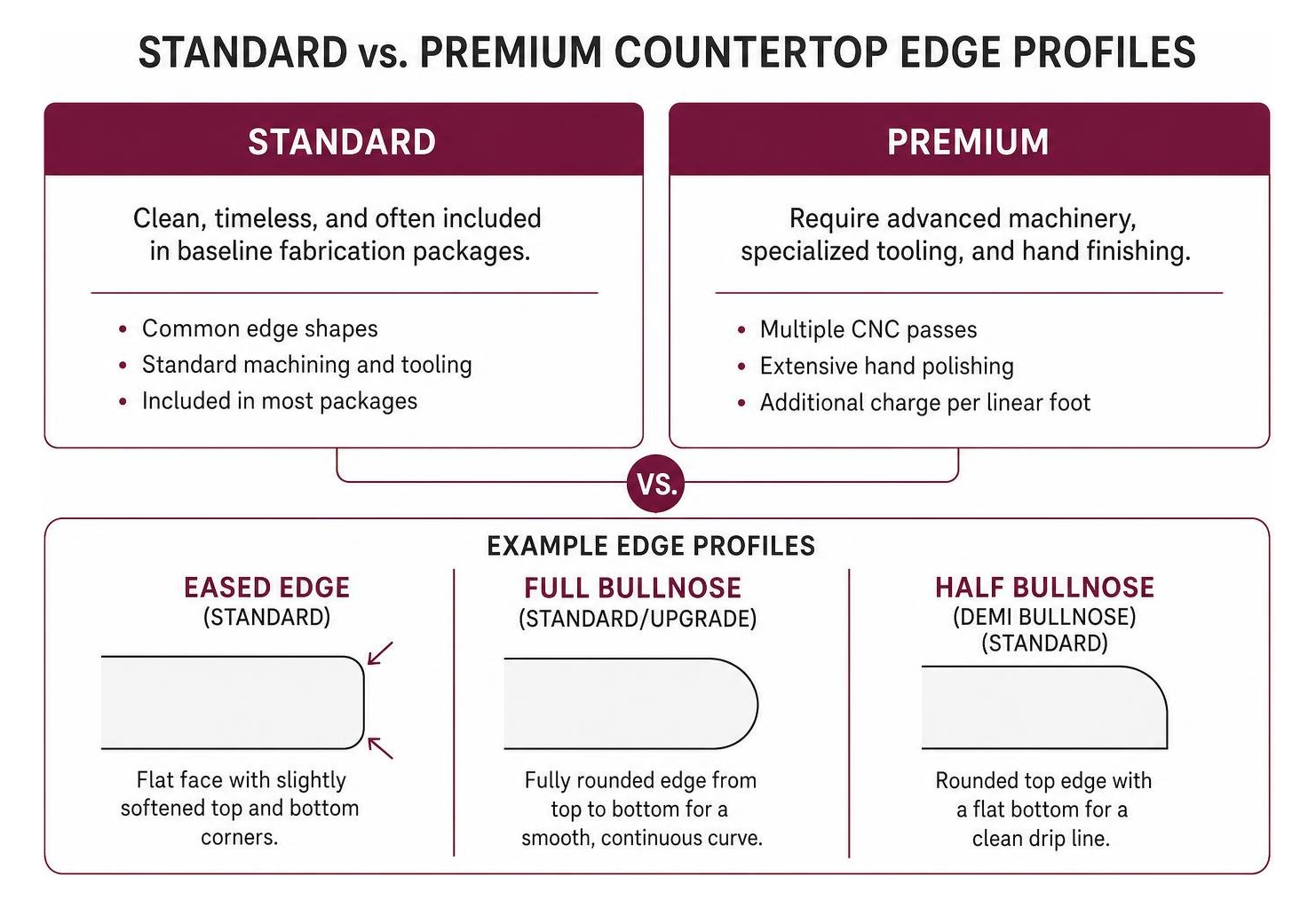
Fabricators generally divide edge shapes into standard and premium categories based on the machinery, diamond tooling, and hand-polishing labor required to produce them. Standard edges are clean, timeless, and frequently included in baseline fabrication packages. Premium profiles, on the other hand, require multiple passes with specialized CNC machinery and extensive hand finishing, which incurs an additional charge per linear foot.
Here is a closer look at the most common profiles across both categories:
- Eased Edge (Standard): The minimalist champion. An eased edge features a flat vertical face with softened 90-degree corners (typically a 1/8-inch radius) on the top and bottom. It provides crisp geometry without sharp lines, maximizing usable flat counter space and offering effortless cleaning.
- Full Bullnose (Standard/Upgrade): A fully rounded, semicircular curve that flows smoothly from the top surface down to the bottom. It softens the room visually and is exceptionally gentle if bumped into, though liquids can follow the curve and drip onto cabinet fronts below.
- Half Bullnose / Demi Bullnose (Standard): Features a smooth, rounded top edge paired with a flat, straight bottom drop. This gives you the comfortable feel of a rounded curve while the flat bottom edge acts as a practical drip line for everyday spills.
- Bevel Edge (Standard): Characterized by a sharp, angled 45-degree cut along the top corner. It creates a crisp, tailored facet that catches overhead lighting beautifully, bringing architectural definition to modern or transitional spaces.
- Ogee Edge (Premium): An elegant, S-shaped contour consisting of a gentle concave curve that transitions seamlessly into a convex arch. Deeply rooted in classical architecture, the ogee pairs magnificently with traditional designs, though the recessed groove requires regular wiping to keep crumbs and dust from settling.
- Dupont Edge (Premium): Often described as where classical architecture meets sophisticated luxury. The Dupont features a sharp 90-degree drop at the top surface that flows outward into a sweeping rounded bullnose curve.
- Mitered Edge (Premium): Created by joining two stone pieces cut at precise 45-degree angles along the perimeter. This engineering feat allows a standard 2 cm or 3 cm slab to present the bold, striking illusion of an ultra-thick, solid block of stone.
| Edge Profile | Category | Best Aesthetic Match | Maintenance Level | Relative Cost |
|---|---|---|---|---|
| Eased | Standard | Modern, Contemporary, Transitional | Very Low | Baseline / Included |
| Half Bullnose | Standard | Transitional, Traditional, Family Kitchens | Low | Baseline / Minor Upgrade |
| Full Bullnose | Standard | Traditional, Soft Casual | Moderate | Baseline / Minor Upgrade |
| Bevel (45°) | Standard | Transitional, Modern Farmhouse | Low | Baseline / Minor Upgrade |
| Ogee | Premium | Traditional, Classical, French Country | Moderate | Premium Upgrade |
| Dupont | Premium | Formal Traditional, Old World | Moderate | Premium Upgrade |
| Mitered Apron | Premium | Ultra-Modern, Luxury Contemporary | Low to Moderate | High Premium Upgrade |
Specialty Options: Chiseled, Waterfall, and Postformed Laminate
Beyond standard and premium profiles, specialty treatments allow homeowners to make distinctive design statements.
A chiseled edge (also known as a rock-face or raw edge) leaves the outer perimeter mechanically pitched and hand-dressed rather than polished flat. This creates a tactile, organic look that complements rustic mountain homes, Southwestern aesthetics, and outdoor kitchens.
A waterfall edge extends the countertop material vertically down the side of an island or base cabinet all the way to the floor. When paired with high-end engineered quartz or natural stone, a waterfall edge turns your island into a sculptural centerpiece.
While laminate countertops have historically been used as budget-friendly options, they have distinct limitations when compared to solid surfaces. Postformed laminate edges – such as tight 1/8-inch pencil line radiuses or raised “no-drip” front lip contours – are formed by wrapping laminate sheeting over a particle board substrate. While these postformed shapes eliminate harsh glued seams, laminate simply cannot match the long service life, heat tolerance, low-maintenance feel, and structural depth of natural stone or engineered quartz.
Before making a final surface selection, take the time to consider this when choosing new countertops for your kitchen to ensure your investment stands up to decades of everyday use.
Technical Fabrication, Slab Materials, and Protective Trims
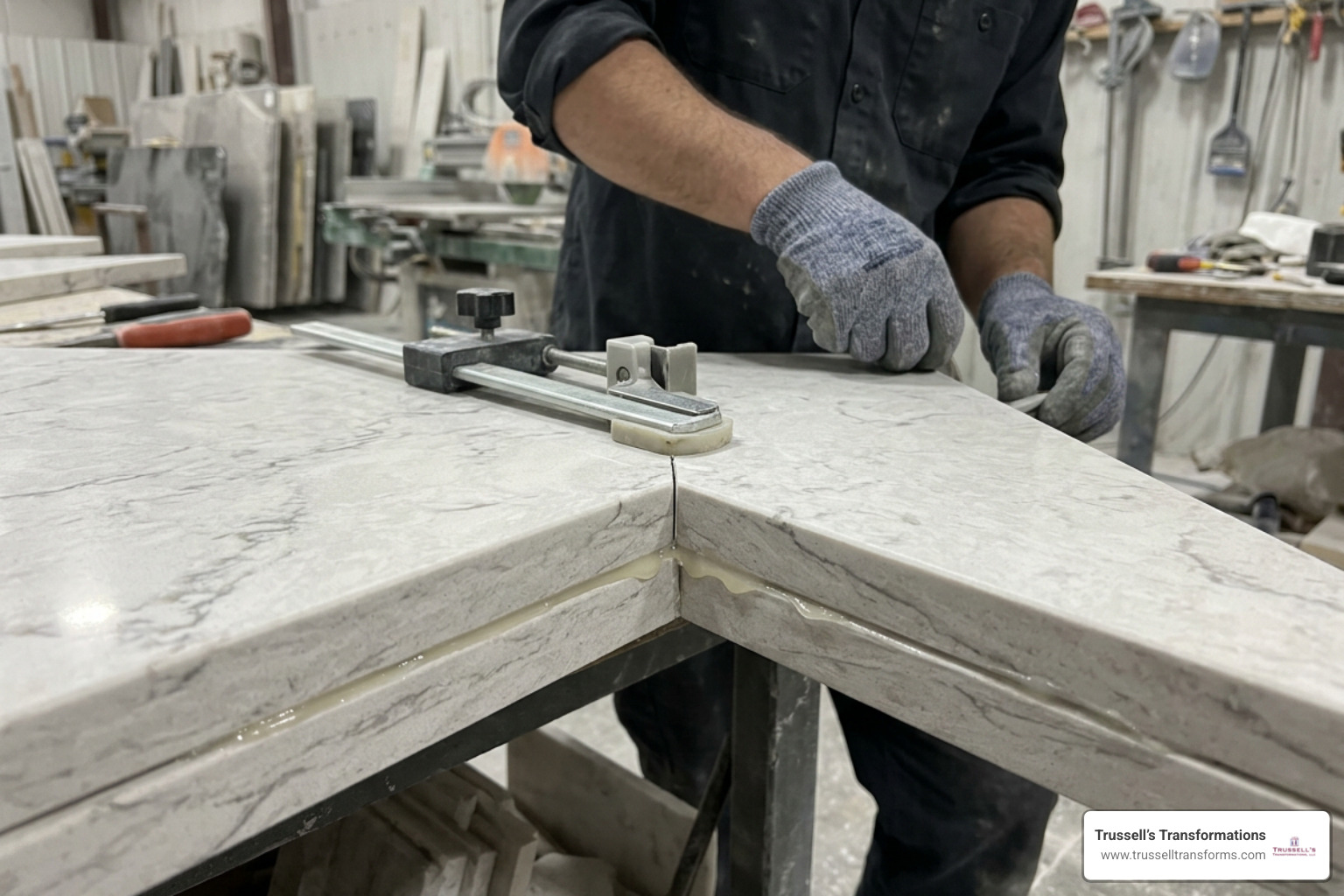
The fabrication process of shaping an edge is a blend of computer-controlled precision and artisan handcrafting. Modern stone shops utilize multi-axis CNC machines equipped with water-cooled diamond router bits to grind the stone into the specified profile. Once the shape is cut, skilled fabricators use progressively finer diamond polishing pads to restore the factory luster and mirror finish to the cut edge.
Understanding the technical nuances of your chosen material is vital. Comparing quartz vs granite countertops reveals key fabrication differences:
- Granite and Natural Quartzite: Naturally formed igneous and metamorphic stones possess varying grain structures, natural fissures, and mineral hardness. Intricate profiles like a double ogee can require slower tooling, careful feed rates, and additional hand finishing on large-crystal granites.
- Engineered Quartz: Composed of roughly 90-93% crushed quartz bound with polymer resins, engineered quartz offers uniform structural density without hidden fissures. This makes it an exceptional medium for crisp eased cuts, intricate profiles, and razor-sharp mitered waterfalls.
In our Albuquerque showroom, we showcase premier quartz and natural stone brands known for their superior performance, including Caesarstone, Cambria, Silestone, and curated natural slabs from The Stone Collection. Investing in engineered quartz or granite rather than laminate gives you a premium, long-lasting surface with stronger heat tolerance, richer visual depth, and better day-to-day usability for a high-value kitchen or bath renovation.
Material Considerations for Natural Stone, Engineered Quartz, and Tile
When working with heavily veined marble, quartzite, or luxury quartz patterns, edge selection plays a critical role in visual continuity. Straight, eased, and mitered edges preserve the natural direction of flowing veins as they transition from the horizontal surface to the edge face. Complex profiles like the ogee cut deeply into the stone thickness, which can interrupt directional veining patterns.
For homeowners incorporating tiled countertops, tile feature strips, or wet-area accents, prefabricated architectural trim profiles offer a clean alternative to standard bullnose trim pieces. These profiles create crisp exposed edges and polished transitions between materials:
- Aluminum Edge Trims: Sleek profiles such as the L-Shape Edging Profile Made of Aluminum (LS1) cap exposed tile edges to produce clean, minimalist transitions between materials. For textured or colored aesthetics, options like the L-Shape Edging Profile Made of Texture Coated Aluminum (LS4) and Round Edge Profiles Made of Texture Coated Aluminum (RO4) allow you to color-coordinate trims directly with surrounding grout lines.
- Decorative Counter Trims: Products like Counter Trim Profiles (CT1) provide a front-facing channel to insert a matching mosaic or tile feature strip along the countertop apron.
- Stainless Steel Edge Protection: For maximum chemical resistance and heavy-use durability, the Round Edge Profiles Made of Stainless Steel (RO5) and L-Shape Edging Profiles Made of Stainless Steel (LS5) utilize Marine-grade 304 or 316 stainless steel with a 250 HB hardness rating, creating a refined finish for demanding residential or light commercial applications.
Laminated Edges and Mitered Aprons for Thicker Aesthetics
Most standard stone slabs are manufactured in 2 cm (approx. 3/4-inch) or 3 cm (approx. 1-1/4-inch) thicknesses. If your design vision calls for a dramatic, thick 2-inch to 4-inch countertop slab, you do not need to hunt down an impossibly heavy solid quarry block. Instead, fabricators utilize two primary build-up methods:
- Stacked Lamination: A secondary strip of matching stone is adhered directly beneath the front overhang using color-matched epoxy. The fabricator then profiles and polishes across both pieces simultaneously. While cost-effective, a fine horizontal seam line may be faintly visible along the side edge.
- Mitered Apron: The top slab and a vertical drop skirt are cut at corresponding 45-degree angles and joined seamlessly. This technique wraps the surface pattern smoothly over the corner, creating the authentic appearance of a massive, monolithic slab without excessive weight.
Functional Design Factors: Cleaning, Usable Space, and Layouts
A countertop edge should not be chosen based on looks alone; it must also serve your household’s daily lifestyle.
From a maintenance standpoint, simpler is always easier. Intricate profiles containing grooves, stepped ledges, or deep curves (like double ogees or Dupont profiles) naturally catch stray breadcrumbs, flour, and grease splatters. Keeping them pristine requires wiping along the channel with a microfiber cloth or soft brush. In contrast, an eased or half-bullnose edge wipes down with a single swipe of a sponge.
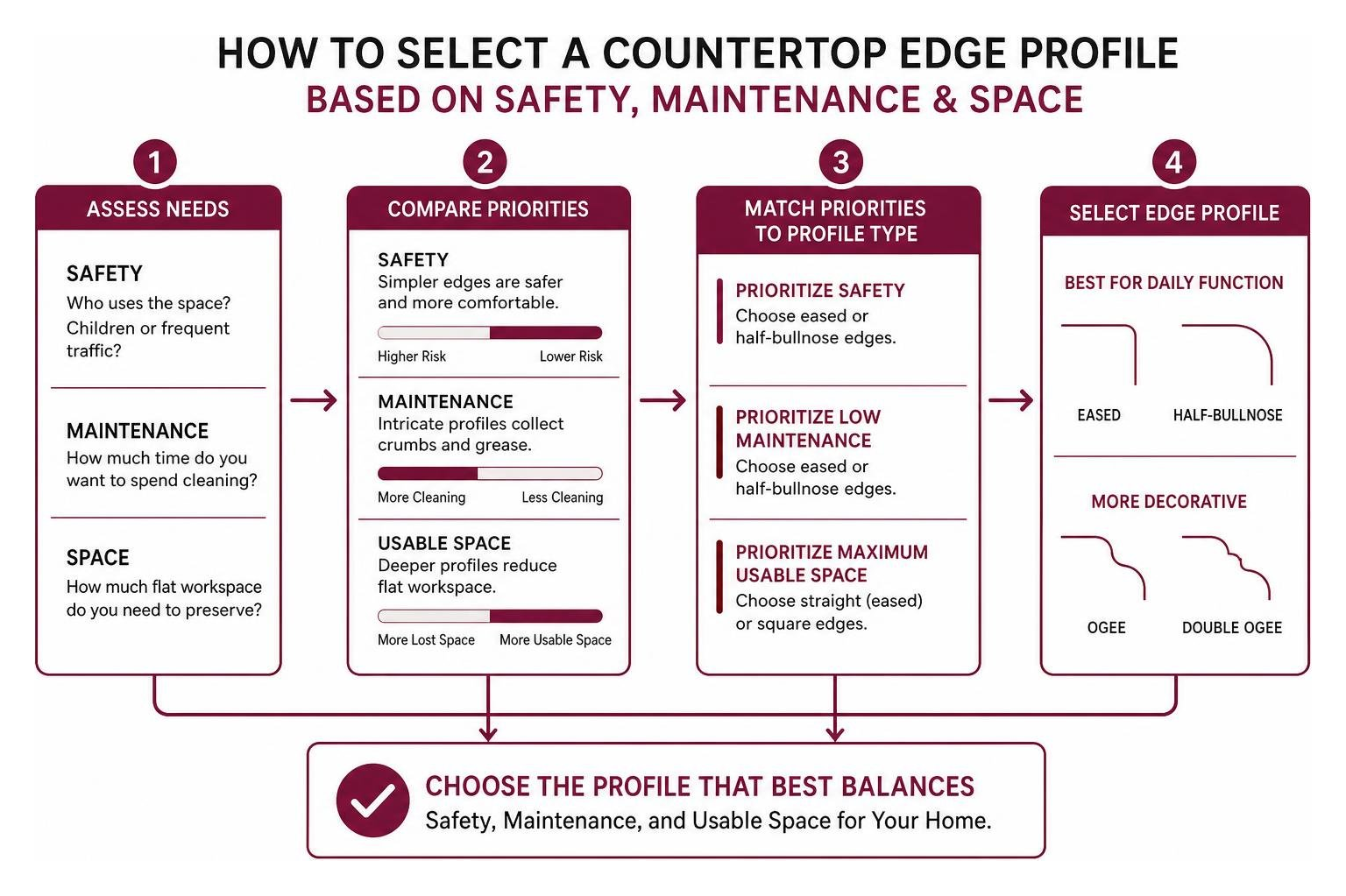
Usable workspace is another functional factor. Deeply profiled edges carve away from the top flat surface. A standard eased profile preserves virtually 100% of your flat horizontal workspace, whereas a long-slope ogee can reduce the flat usable surface by up to 3/4 of an inch around the entire room perimeter. In compact kitchens with limited square footage, keeping edges tight and straight preserves critical prep area.
To explore how different materials balance these functional needs across your specific neighborhood layout, read the ultimate guide to finding granite countertops in your neighborhood.
Coordinating Countertop Edge Profiles on Islands and Perimeters
You are not required to use the exact same edge profile across every run of cabinetry in your home. In fact, blending complementary profiles is one of the most effective ways to establish a high-end, designer look without overextending your renovation budget.
A popular design strategy is featuring a bold, premium edge on the central kitchen island while keeping perimeter counters in a clean, standard profile. For instance, pairing a dramatic mitered apron or an ornate ogee on the island with a crisp eased edge along the perimeter walls creates an eye-catching focal point. Because custom edges are billed by the linear foot, limiting complex profiles to the island keeps overall fabrication costs manageable.
When mixing profiles, maintain design cohesion by sticking to complementary silhouettes. Pair geometric profiles together (such as a bevel perimeter with a mitered island) or soft curves together (such as a half bullnose perimeter with an ogee island). You can explore full design and fabrication coordination through our dedicated Countertop Services page.
To visualize how different profiles interact with your stone patterns before fabrication begins, review physical edge samples with the Trussell’s Transformations design team during your showroom consultation.
Why Professional Planning and Paid Estimates Matter
Achieving seamless countertop installations requires meticulous early planning. When investing in high-grade stone, professional 3D design renderings, laser-templated measurements, and architectural blueprints are non-negotiable.
This is why paying for a professional remodeling estimate is one of the smartest investments you can make during a renovation. A thorough, paid consultation covers on-site laser templating, structural subfloor and cabinetry levelness verification, seam layout optimization, and photorealistic renderings. Rushing into fabrication with a quick “back-of-the-napkin” estimate often results in unaligned stone veining, uneven overhangs, and costly material waste. Thorough planning ensures every miter cut, sink cutout, and edge radius fits your custom cabinetry seamlessly on installation day.
Frequently Asked Questions About Edge Treatments
Can you mix two different edge profiles in the same kitchen?
Yes, mixing edge profiles is a popular design technique when done intentionally. The most successful approach is using a statement edge profile (such as an ogee, Dupont, or thick mitered apron) on the central kitchen island while utilizing a subtle standard profile (like an eased or half bullnose) along the perimeter countertops. This highlights the island as the architectural centerpiece of the room while keeping your budget balanced.
How does an edge profile impact usable countertop surface area?
Edge profiles featuring sweeping bevels, deep steps, or extended slopes cut into the top horizontal plane of the stone slab. A wide ogee or deep Dupont profile can reduce your flat work surface by 1/2 inch to 3/4 inch along every exposed run. In compact kitchens where prep space is at a premium, opting for an eased or tight 1/8-inch pencil radius edge maximizes flat, functional counter space.
Why are edge profiles priced by the linear foot instead of square footage?
While stone slabs are purchased and measured by square footage, edge profile fabrication requires specialized labor, CNC router tooling time, and hand-polishing along the exposed outer boundary only. Because the work is focused solely on the edge perimeter rather than the entire surface area, fabricators price standard edge upgrades, laminated drops, and mitered build-ups by the running linear foot.
Conclusion
The countertop edge profile you select provides the finishing architectural touch that unites your cabinetry, stone surfaces, and overall kitchen aesthetic. Whether your project calls for the crisp, contemporary lines of an eased edge, the classical elegance of an ogee contour, or the bold presence of a thick mitered waterfall, getting the detail right ensures your renovation looks balanced and intentional for decades to come.
For Albuquerque and Rio Rancho homeowners looking to bring their dream spaces to life, Trussell’s Transformations is your trusted, one-stop remodeling partner. With over 25 years of experience across Bernalillo County, NM, our licensed contractors deliver turnkey kitchen and bathroom renovations—from stunning cabinetry and premium quartz and granite installations to complete flooring and structural remodels. We offer full design support, comprehensive planning, and flexible 0% financing options to make your renovation seamless from start to finish.
Ready to explore edge profiles and stone slabs in person? Check out our complete resource on countertop edge profiles explained for Albuquerque homeowners or visit our showroom at 8023 Edith Blvd NE to start planning your transformation with our design team today!
Recent Comments