

Cabinet Maker vs. Carpenter: What’s the Difference and Why It Matters for Your Remodel
A cabinet maker carpenter refers to two distinct — but often confused — woodworking trades. Here’s the quick answer:
| Cabinet Maker | Carpenter | |
|---|---|---|
| Where they work | Shop (indoors) | Job site (outdoors/on-site) |
| What they build | Cabinets, built-ins, furniture, trim, millwork | Frames, decks, structural elements |
| Precision level | Very high (fine tolerances) | Moderate (structural focus) |
| Best for | Kitchen cabinets, bathroom vanities, custom built-ins | House framing, decking, pergolas |
As the saying goes in the trades: “The difference between a carpenter and a cabinet maker is a quarter of an inch.” That gap in precision matters a lot when you’re remodeling a kitchen or bathroom.
Many homeowners planning a remodel don’t realize these are separate specialties. Hiring the wrong trade for the job can mean poor fit, wasted money, and results that don’t match your vision.
For Albuquerque homeowners weighing a kitchen or bathroom upgrade, understanding this difference is the first step toward making a smart hiring decision — and getting results you’ll love for years.
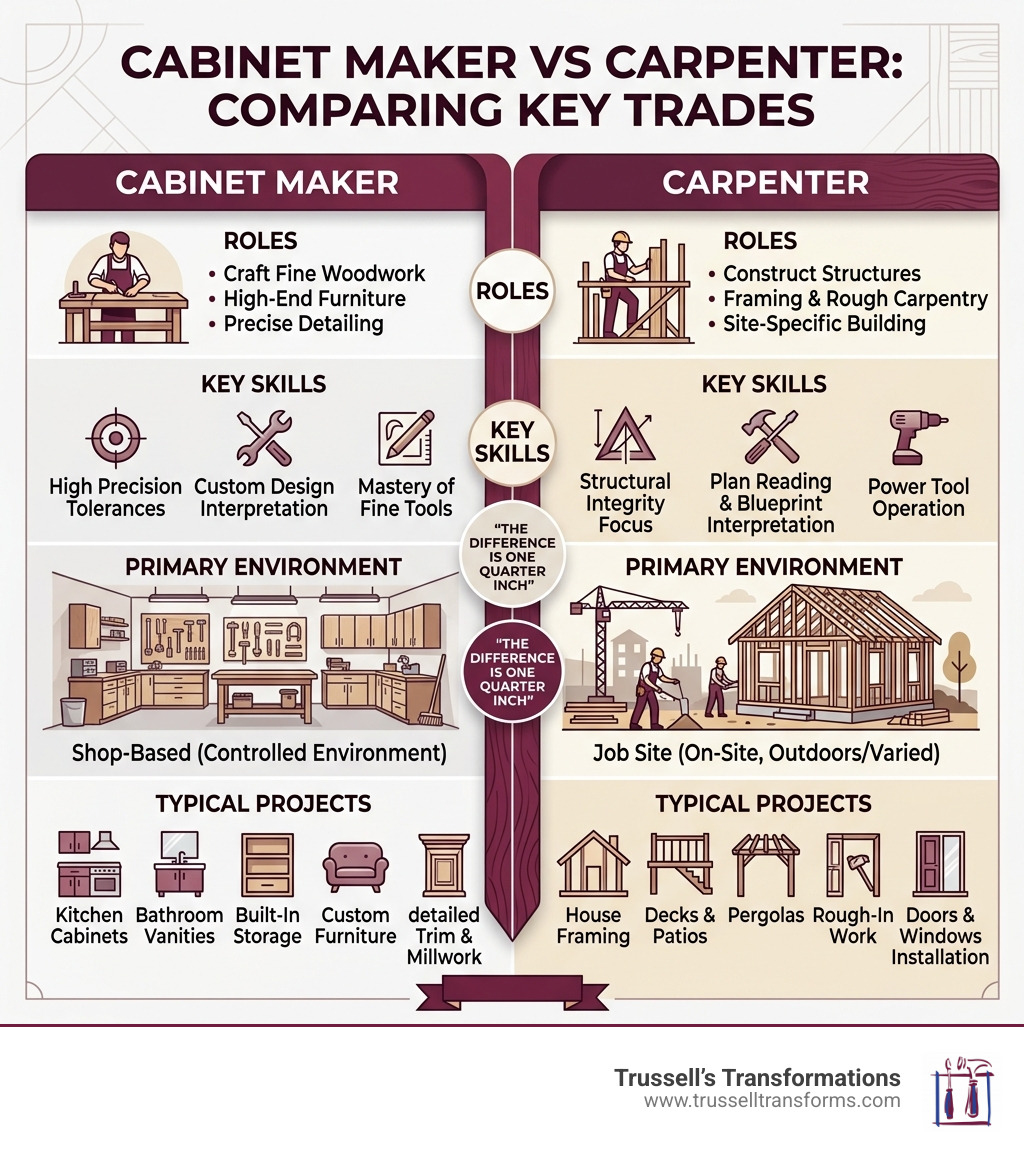
Cabinet Maker vs. Carpenter: Understanding the Primary Differences
When you are standing in your kitchen in Albuquerque, looking at a cabinet door that won’t close or dreaming of a brand-new island, you might wonder: “Do I call a carpenter or a cabinet maker?” While both work with wood, their worlds are miles apart in terms of daily environment and the “math” they use.
Shop-Based vs. Site-Based
The most immediate difference is where the magic happens. A cabinet maker is primarily shop-based. They work in a controlled environment where the floors are level, the temperature is steady, and the lighting is perfect. This allows them to focus on “fine joinery”—the art of making two pieces of wood meet so perfectly you can barely see the seam.
A carpenter, on the other hand, is usually site-based. They are the heroes on the construction site, dealing with Albuquerque’s wind, uneven ground, and the structural realities of a building. They handle “structural framing,” which is the skeleton of your home. If you need a new wall moved or a deck built, you want a carpenter. If you want a custom kitchen cabinet that fits into a specific nook with millimeter precision, you need a cabinet maker.
Precision Levels and Tolerances
In a general carpenter, being off by an eighth of an inch might be acceptable for a house frame that will eventually be covered by drywall. However, for a cabinet maker carpenter, an eighth of an inch is a canyon. Cabinetry requires “fine tolerances.” We’re talking about measurements so precise that even the thickness of a coat of paint must be accounted for so that drawers slide smoothly and doors hang straight.
Project Scope
- Carpenters handle: House frames, roofing, floor joists, exterior siding, decks, and pergolas.
- Cabinet makers handle: Kitchen and bathroom cabinets, wardrobes, intricate trim, mantels, and bespoke furniture.
| Feature | Cabinet Maker | Carpenter |
|---|---|---|
| Primary Focus | Internal fittings & aesthetics | External structures & skeleton |
| Environment | Controlled woodshop | Dynamic construction site |
| Tools | Table saws, jointers, CNC routers | Circular saws, nail guns, levels |
| Key Skill | Intricate joinery and finishing | Structural integrity and speed |
The Specialized Skills of a Cabinet Maker Carpenter
Becoming a master in this field isn’t something that happens over a weekend of DIY videos. It is a highly technical trade that requires a massive investment of time. In the professional world, a certified cabinet maker often undergoes an apprenticeship that requires approximately 7,000 hours of on-the-job training (OJT) and 640 hours of classroom learning.
Precision Tools and Technology
While a hammer and a hand saw are the classic symbols of woodworking, the modern cabinet maker carpenter uses high-tech machinery. This includes the CNC (Computer Numerical Control) router, which uses computer programming to cut wood with a level of accuracy that the human hand simply cannot replicate.

Beyond high-tech machines, these professionals must be experts in:
- Blueprint Reading: Translating an architect’s or designer’s vision into a physical object.
- Material Estimation: Calculating exactly how much hardwood or veneer is needed to minimize waste and keep costs down for the homeowner.
- Quality Control: Inspecting every grain of wood for defects and ensuring every joint is reinforced with the right fasteners or adhesives.
The Economics of the Trade
According to national labor statistics, the mean annual wage for cabinetmakers is approximately $44,620 (or $21.45 per hour). However, this varies wildly based on skill level and location. In the top 90th percentile, highly skilled makers can earn upwards of $60,800. These figures reflect the “bench carpenter” roles, but for those who transition into management or specialized custom shops, the earnings can be significantly higher.
Career Progression from Apprentice to Journeyman
The path to becoming a “Journeyperson” is rigorous. It’s a journey from being a pair of extra hands to becoming a master of the craft:
- First-Year Apprentice: Focuses on safety, basic tool use, and shop cleanliness. Earnings typically range from $33,436 to $46,363.
- Third-Year Apprentice: Handles more complex assembly and begins learning specialized finishing techniques. Earnings grow to between $51,666 and $71,646.
- Journeyperson: A fully qualified professional capable of running projects from start to finish.
- Foreman/Superintendent: These leaders oversee entire shops or large-scale commercial installations, with salary potentials reaching $98,100 to $131,018.
When to Hire a Professional for Your Home Remodel
We love the “can-do” spirit of Albuquerque homeowners, but there are times when DIY or a “handyman” just won’t cut it. Cabinetry is the most visible part of your kitchen or bathroom. If the lines aren’t straight, you will notice it every single day.
You should hire a professional cabinet maker carpenter when your project involves:
- Custom Cabinetry: When “off-the-shelf” sizes don’t fit your unique floor plan.
- Intricate Trim: Crown molding or wainscoting that needs to wrap perfectly around corners.
- Architectural Built-ins: Creating a library wall or a custom entertainment center that looks like it grew out of the architecture of your home.
One of the biggest questions we hear is, Should I choose pre-made or custom-built cabinets? While pre-made options are faster, custom cabinets allow you to maximize every inch of storage and choose materials that will last a lifetime. If you want to truly transform your space with custom cabinets, the precision of a cabinet maker is non-negotiable.
Why Quality Materials and Licensed Contractors Matter
In Albuquerque and Rio Rancho, we’ve seen what happens when homeowners try to save a few dollars by hiring unlicensed labor or using “big box” bargain materials. The desert climate is tough on wood; low-quality cabinets can warp or delaminate within just a few years.
At Trussell’s Transformations, we believe in accountability. That’s why we only work with brands that have a proven track record for durability and style.
Our Cabinetry Partners
We carry names that represent the gold standard in the industry:
- DuraSupreme Cabinetry: Known for incredible customization and high-end finishes.
- Waypoint Living Spaces: Offers a fantastic balance of style and durability.
- Sollid Cabinetry: Built with a focus on quality construction that stands the test of time.
- Kitchen Cabinet Distributors: Great for those looking for quality without the custom-built price tag.
The Finishing Touch: Countertops
A cabinet is only as good as what’s sitting on top of it. We pair our cabinetry with premium stone surfaces from Caesarstone, Cambria, and Silestone, as well as unique finds from The Stone Collection.
Hiring a licensed contractor ensures that your heavy stone countertops are supported by cabinets that are structurally sound and perfectly level. Proper cabinet installation: 3 things you need to know involves more than just a few screws; it requires an understanding of weight distribution and wall anchoring that only a pro provides.
Frequently Asked Questions About Cabinet Maker Carpenters
Can a Cabinet Maker Carpenter handle both structural and fine wood projects?
There is certainly a skill overlap. Many cabinet makers started as general carpenters and moved into the shop to pursue higher precision. However, they are different mindsets. A professional focused on fine cabinetry is used to working with “finish carpentry” standards. While they can build a deck, their time and specialized tools are usually better spent on interior finishes and custom solutions where their eye for detail shines.
If you are looking for someone to manage the entire process, it’s best to hire a company like ours that employs experts in both areas. You can learn more about why Trussell’s Transformations is the leading cabinet installer in Albuquerque and how we bridge the gap between structural work and fine finishing.
What is the job outlook for the cabinet making industry?
The industry is currently in a state of transition. Nationally, there are about 86,000 jobs, with a projected growth that is slightly declining (-1% or lower) due to the rise of automated manufacturing. However, the demand for bespoke, high-end cabinet makers remains strong. People still value the “human touch” and custom designs that machines can’t fully replicate.
When should a homeowner hire a carpenter instead of a cabinet maker?
For large-scale structural work like house framing, adding a new room, or major external structures like a gazebo, a general carpenter is required. Their focus is on structural integrity, building codes, and speed. A cabinet maker is your go-to for anything that requires a “finished” look—think of them as the artists of the woodworking world. If you want to see the difference in person, the art of craftsmanship: cabinet makers in Albuquerque is best viewed in a professional showroom.
Conclusion
Choosing between a cabinet maker and a carpenter doesn’t have to be a headache. If you are building the “bones” of a house, find a carpenter. If you are building the “soul” of your home—the kitchen where you gather, the bathroom where you start your day, or the custom library you’ve always wanted—you need the precision of a cabinet maker.
At Trussell’s Transformations, we’ve spent over 25 years serving the Albuquerque and Rio Rancho communities. We are a one-stop shop, meaning we handle everything from the initial design in our showroom to the final professional installation by licensed contractors. We even offer 0% financing to help make your dream remodel a reality.
Ready to see the difference that professional precision makes? Visit us at our Albuquerque showroom at 8023 Edith Blvd NE, or explore our professional cabinet services online today. Let us help you transform your house into the home you’ve always envisioned.
Recent Comments